

Will a Mandatory Professional Register for Real Estate Agents Solve the Problem?
Minister Boekholt-O’Sullivan is working on a proposal to introduce a mandatory professional register for real estate agents in the Netherlands. Under this proposal, all real estate agents would be required to register, and those who seriously violate the rules could receive a red card and be banned from working as real estate agents in the Netherlands.
The big question is: will this actually solve the problem? Let’s share some important insights.
Real Estate Agents Leaking Information
Every couple of years, the Dutch consumer television programme Radar seems determined to portray real estate agents as shady characters by using hidden-camera footage showing buying agents trying to extract information from selling agents.
And so what?
Being clever, persuasive, building relationships and trying to obtain strategic information is actually part of a buying agent’s job.
At Dutch Realtor Training, we even teach real estate agents how to approach this strategically. And guess what? This is NOT in violation of the professional codes of ethics and conduct of NVM and Vastgoed Nederland. Go ahead and read them yourself.
Why? Because as a buying agent, your job is to achieve the best possible result for your client.
You will never completely eliminate selling agents who leak information. And if you’re a buying agent who doesn’t try to obtain strategic information, you’re already 3–0 behind, because the five buying agents who came before you probably did exactly that.
However, what is absolutely unacceptable is a selling agent who cannot keep their mouth shut.
The professional codes of conduct of NVM and Vastgoed Nederland are very clear about this. Leaking information about existing bids is absolutely prohibited.
As far as we’re concerned, that deserves a red card. We also teach every real estate agent never, ever to do this.
Taking action against dishonest selling agents is an excellent idea. But whether it is actually achievable is another question. More on that later.
Your Offer Was Accepted, but Someone Else Outbid You Anyway
Can we PLEASE stop all the pathetic whining about being outbid after your offer has already been accepted?
Do you honestly think we, as real estate agents, enjoy it when another higher offer suddenly comes in the next day?
Do you think we’re celebrating because we might earn an additional 1% commission on a €50,000 higher offer, while having to tell you, with a smile on our faces, that your dream home has slipped through your fingers?
This genuinely makes me angry.
For the thousandth time: it is NOT the real estate agent’s fault.
No signed purchase agreement = no legally binding purchase.
If another higher offer comes in, the selling agent is legally obliged to present it to the sellers. And that new offer could easily be €50,000 higher.
For Radar, the Dutch Homeowners Association (Vereniging Eigen Huis) and the media, a buyer losing their dream home in this way is the perfect opportunity to point an accusing finger at the real estate agent once again.
Hopefully, people will finally understand that the agent can do ABSOLUTELY NOTHING about this and that we also find it extremely frustrating when it happens.
Real Estate Agents Who Use Lies to Push Up the Price
What is genuinely unacceptable, and should be punished severely, is when a selling agent tells a potential buyer:
“Just increase your offer by another €10,000 and the property is yours.”
Later, the bidding log reveals that there wasn’t even a higher competing offer. The agent was simply playing a dirty game to squeeze another €10,000 out of the buyer.
When this happens, we consider it extremely serious. These rotten apples should be kicked out of the real estate industry as quickly as possible.
Will Minister Boekholt-O’Sullivan’s proposed register solve this problem?
We’ll get to that shortly.
There is, however, an important distinction between lying about competing bids and simply negotiating.
During negotiations, it’s perfectly acceptable to say that if the buyer increases their offer by a certain amount, a deal can be reached.
That’s just normal negotiation. Making a deal. Shaking hands.
That is completely different from inventing competing offers that don’t actually exist.
Real Estate Agents Prefer Doing Business with Other Real Estate Agents
As we’ve explained many times in our blogs and videos, real estate agents prefer doing business with other real estate agents.
Fact.
Don’t cry about it. That’s simply how it works.
And I’m going to explain one more time why this happens and how selling agents should deal with it professionally and ethically.
Imagine there are two identical offers.
Both are €450,000.
Both are subject to a satisfactory building inspection.
Both include a four-week mortgage financing contingency.
Offer A comes from a buyer without a buying agent.
Offer B comes from a buyer represented by a buying agent.
Let’s make the example a little more interesting.
The buyers submitting Offer A seem fairly inexperienced. As the selling agent, I’ve already pointed out several maintenance issues with the property.
I’ve also asked whether they’ve consulted a mortgage adviser.
Their answer?
“Oh, we can easily borrow the money. We checked it using an online mortgage calculator.”
Now let’s look at Offer B.
I know the buying agent representing these buyers very well.
This buying agent only accepts clients who have already had their finances thoroughly assessed by a qualified mortgage adviser. A real human being, not an online calculator.
The buying agent is highly experienced.
During and after the viewing, the agent has carefully explained the property’s maintenance issues and managed the buyers’ expectations, making it clear that at least €30,000 will need to be invested in the property.
So how should a selling agent handle this situation?
The WRONG Approach
You, as the selling agent, choose Buyer B because their offer comes through a buying agent.
WRONG.
This is NOT the correct approach because YOU are not the person who gets to choose.
Your responsibility is to present the offers to YOUR CLIENT.
You do not make the decision.
YOUR CLIENT, the seller, makes the final decision.
The RIGHT Approach
You present both offers to your client and advise them which offer you believe is most attractive, explaining your reasoning.
It is entirely possible that you might recommend Buyer A, who has no buying agent, because their personal circumstances better match the seller’s previously expressed preferences.
However, most sellers simply want the offer that makes the most commercial sense.
And in that situation, you will often advise your client to accept the offer submitted WITH a buying agent.
Yes, Radar and all the other sensationalist television programmes, pay attention.
That’s right. I said it.
And the explanation is incredibly simple.
That offer presents the lowest risk of — I’m just going to say it — HASSLE.
Did I really just write “hassle”?
Yes. HASSLE!
Here are some examples of the problems that can arise when buyers purchase a property without a buying agent:
- Buyers panic during the building inspection because numerous maintenance issues are identified that they hadn’t anticipated. An experienced buying agent would often have identified many of these issues beforehand.
- Buyers only visit a real mortgage adviser after their offer has been accepted. They discover that their student loan reduces their borrowing capacity or that their monthly mortgage payments will be significantly higher than expected. Result: they withdraw from the purchase during the statutory cooling-off period.
- Buyers forget to arrange a property valuation in time. Result: they request an extension of the mortgage financing deadline.
- Buyers fail to provide their personal details for the purchase agreement promptly. Result: the purchase agreement cannot even be prepared until a week and a half later.
- Buyers panic when they receive the standard Dutch purchase agreement. After endless emails back and forth, the agreement is finally signed three weeks after their offer was accepted.
- Buyers demand that sellers repair maintenance defects at the sellers’ expense, even though those defects were already known when the purchase was agreed and had been identified during the building inspection. This actually happened in a transaction at Houtplein in Haarlem.
- Buyers repeatedly try to use the selling agent as their own buying agent because they constantly need guidance throughout the process. This frustrates the selling agent because representing the buyer is not their job. In fact, the selling agent must be careful not to serve two principals with conflicting interests, as addressed in Article 7:417 of the Dutch Civil Code.
- Buyers forget to increase their daily bank transfer limit and fail to transfer the remaining purchase funds to the civil-law notary in time. Result: the transfer of ownership must be postponed.
- Buyers forget to bring valid identification to the notary or fail to arrange buildings insurance.
- Even months after completion, buyers continue bothering the sellers and selling agent about everything that breaks or turns out to be defective, trying to hold the selling agent responsible. This has happened in real transactions, including one in Orteliusstraat in Amsterdam.
Conclusion
There is ABSOLUTELY NOTHING WRONG with selling agents preferring to do business with buyers represented by a buying agent rather than unrepresented buyers.
Provided, of course, that the selling agent does not make the decision themselves but instead gives their client a well-reasoned recommendation explaining why the offer submitted through a buying agent may be the better choice.
The final decision must always remain with the seller.
Can Unfair Bidding Practices Actually Be Enforced and Punished?
Short answer: no.
Spoiler alert: if you have a serious complaint against a real estate agent, it can take up to 32 weeks before an independent disciplinary committee issues its decision.
But here’s the bigger problem.
Most of the time, there simply isn’t any evidence.
How are you going to prove that the selling agent was bluffing when they told you to increase your offer by another €10,000 to become the winning bidder?
How are you going to prove that the selling agent leaked the amount of your offer to another buyer?
Good luck with that.
It’s all very nice that the minister wants to introduce a new professional register, but the Netherlands already has established real estate registers, including VastgoedCert, SCVM, MMCEPI and Dutch Realtor Cert.
Independent disciplinary procedures and dispute resolution mechanisms already exist as well.
The problem is that these procedures take so long that you’ll probably have moved house twice before a decision is finally made.
But anyway.
Will Requiring All Real Estate Agents to Hold a Professional Qualification Solve the Problem?
With all due respect, some of the biggest crooks in the industry are real estate agents who already hold an official professional qualification.
Can I prove that?
I don’t think that would be particularly difficult.
Give me one hidden camera with a microphone, and I’ll find you five qualified real estate agents behaving dishonestly within a week.
I’d happily show those fools at The Dutch tv program ‘Tros Radar‘ what proper investigative journalism looks like.
Whether a real estate agent holds an A-RMT, K-RMT, RM or RMT qualification makes absolutely no difference in this respect.
Those qualifications relate to professional education and competence, not necessarily to ethical and professional behaviour.
What might actually help?
Keep reading.
Will a Mandatory Professional Register for Real Estate Agents Solve the Problem?
Remember the main question of this article?
Well, here’s the answer.
NO. It will not solve everything.
And here’s why:
- It remains extremely difficult to monitor whether a selling agent verbally leaks information to a friendly buying agent. Proving that it happened is even harder.
- As long as Dutch law requires a written purchase agreement, it is impossible to prevent another sneaky, higher offer from arriving after an earlier offer has been accepted but before the agreement has been signed. Real estate agents can do ABSOLUTELY NOTHING about that.
- Just like the first point, it remains extremely difficult to prove that a selling agent verbally bluffed about competing offers to persuade a buyer to increase their bid.
- The fact that selling agents sometimes prefer dealing with buying agents can often be perfectly explained and entirely legitimate. Deal with it.
- Dispute resolution and disciplinary proceedings take a very long time. The question is whether these procedures can be accelerated while remaining legally fair and financially affordable.
- Having a professional education or qualification, even if it becomes mandatory, does not automatically make someone an ethical or professional real estate agent.
What CAN Minister Boekholt-O’Sullivan Do to Make the Housing Market Fairer?
For heaven’s sake, please don’t waste millions of euros of taxpayers’ money reinventing the wheel.
Instead, take these three actions.
Action 1: Make a Certified Digital Bidding Log Mandatory
Introduce a legal requirement that all offers must be recorded in a digital bidding log.
This bidding log must comply with the Dutch technical standard NTA 8061.
The system should make it technically impossible for sellers and selling agents to view bids during a closed bidding procedure before the deadline has passed.
That is exactly the kind of protection NTA 8061 is intended to provide.
Currently, this is still possible in certain bidding systems, including Move.
As a result, closed bidding procedures using such systems can be as leaky as a sieve.
The system should also ensure that all participating bidders automatically receive the bidding log once the transaction has been completed and the log can be released.
Action 2: Introduce Substantial Fines for Dishonest Selling Agents
Introduce substantial financial penalties for selling agents who leak confidential information about the amounts of existing bids.
Make those fines EVEN HIGHER if it turns out that a selling agent deliberately provided false or misleading information to drive up the purchase price.
Naturally, fines should only be imposed when the violation can actually be proven.
In addition to a financial penalty, the selling agent could also face disciplinary proceedings under the existing professional disciplinary system.
They could even be removed from their professional register.
That possibility already exists within certain professional registration systems.
Action 3: Spend €5 on Better Consumer Education
Literally.
You know what?
I’ll even do the work for you.
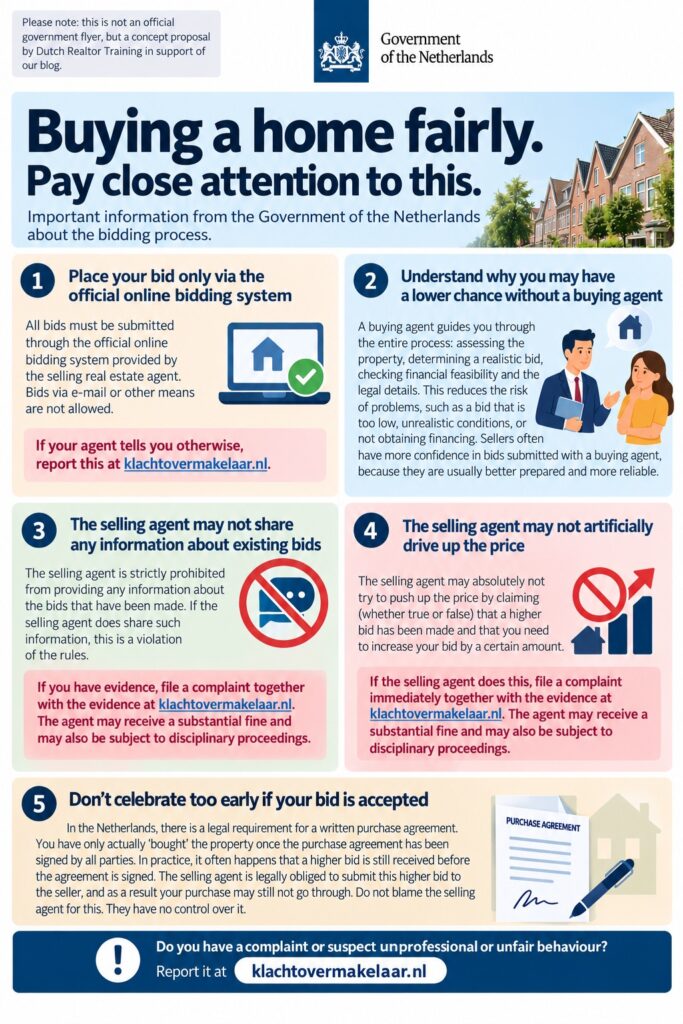
Require selling agents to include an official consumer information flyer, like the example attached to this article, in the property documentation they provide to prospective buyers.
This would make a huge difference.
It would help buyers understand why an accepted offer can still be overtaken by a higher bid before the purchase agreement is signed.
It would inform consumers about the professional rules selling agents must follow.
And it would help buyers understand why they may already be 3–0 behind when trying to purchase a property without a buying agent.
There you go.
You’re welcome.
Want to get started as a real estate agent quickly?
Check out our unique, practical real estate course!